Now: Independent and interviewing, as of August 2026. Days go to the tool line behind this site: Helix, and the agent endpoints the site itself now serves (MCP and A2A). The role I'm looking for is one section down. Chicago-based.
Most recently Senior Developer II at Metafora (Sept 2025 to Aug 2026), building AI agent platforms, release tooling, and cloud migration architecture for logistics and marketplace clients. Before that, Director of Software Development at Next Generation Logistics, and Enterprise Architect (Principal) at Coyote Logistics. For the leveling-minded: Metafora is a consultancy, and Senior Developer II was the top of its engineering ladder; consultancy ladders run short. The title ran smaller than the last two. The mandate did not.
The short version
I spent twenty years learning how software actually gets shipped inside real organizations: payment systems at JPMorgan Chase, a POS platform run by 400-500 sporting-goods retailers, a deployment design for an 80,000-node healthcare estate, a hybrid Azure estate at Coyote Logistics, a crypto exchange that traded $22M in its first 48 hours.
Then the job changed. In 2023 I led GitHub Copilot adoption across a 900-repo engineering org and ended up in the Wall Street Journal and the GitHub Galaxy keynote for it. In 2024 I inherited nine customers' worth of undocumented .NET from a developer who had passed away, and got a 3.5-person team to a 250% productivity increase in six weeks using a multi-agent framework I built. In 2026 I shipped four products in five months where three quarters of the commits had an agent in the loop.
Notice what those have in common: not one of them is about how fast I work. The WSJ piece and the keynote are adoption stories about several hundred people changing how they build. The 250% was 3.5 developers becoming competent in a codebase nobody alive understood. And the thing people keep recommending me for is teaching, not any of the software below. That has become steadily more true across my career. Twenty of the twenty-nine recommendations on my LinkedIn profile say so independently.
Plenty of people are enthusiastic about AI. I'm an engineer who measured it, and then taught it.
What I'm looking for
A role where the deliverable is other engineers' effectiveness.
Concretely: pick up an engineering organization that's somewhere between skeptical and overwhelmed about AI, and leave it measurably faster, with the tooling, the guardrails, the curriculum, and the evidence to keep going after I'm not there.
I've done that as a principal architect, as a director, as a consultant, and as the person who just happened to build the tool everyone started using. I care much more about the shape of the work than the shape of the title, and two names fit the work best: Principal/Distinguished-track engineer or Head of Developer Enablement.
The other half of the role is the bridge between product owner and engineer. I've taken products from scratch to market more than once, for myself and for other people's companies, and I know the complexities that live between an idea and a paying customer: the greenlight that takes four years, the launch that has to survive its own success, the nine customers attached to a codebase with no documentation. Someone who watched me work the cloud program at Coyote called it "being able to recognize where the business was and helping to build the bridge into the vision Coyote had heading into the cloud."
I still build. I build to prove points. The four below are the proof.
The full record on teaching, upskilling, and adoption →
From scratch to market: the business record →
Track record
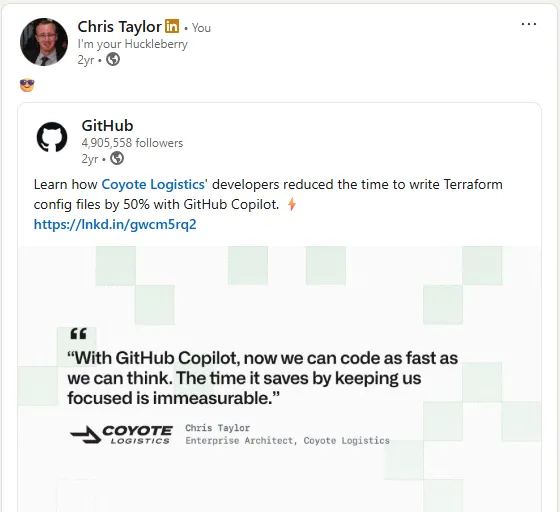 GitHub, to its 4.9M followers: "Coyote Logistics' developers reduced the time to write Terraform config files by 50% with GitHub Copilot." The pull-quote is mine. |
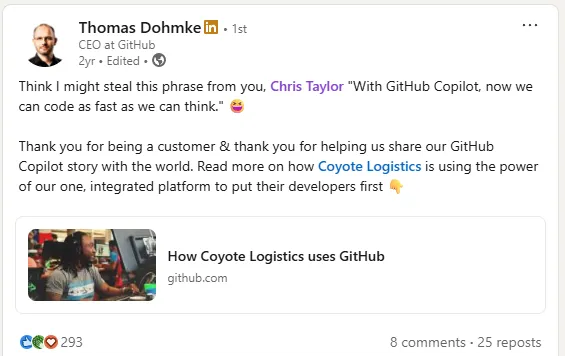 Thomas Dohmke, CEO at GitHub: "Think I might steal this phrase from you, Chris Taylor: 'With GitHub Copilot, now we can code as fast as we can think.'" |
| Proof point | Detail |
|---|---|
| 30+ engineers certified | Co-founded the Coyote DevOps Curriculum and mentored 30+ engineers through modernization and into Microsoft certifications |
| 23 people, 18 months | Interim development manager over development and QA on the Axis point-of-sale platform (via Polaris Solutions) |
| Conference speaker | .NET user groups, architecture panels, QUEST QAI 2016, Dev Up 2016 |
| Wall Street Journal | Generative AI Helping Boost Productivity of Some Software Developers: "We can code as fast as we think." |
| GitHub Galaxy 2023 | Featured in the keynote by Inbal Shani and Thomas Dohmke, watch |
| GitHub customer story | How Coyote Logistics uses GitHub |
| Terraform time cut 50% | Time to write Terraform config files, cited by GitHub in its own Copilot customer marketing (Coyote Logistics) |
| 900+ repositories | Migrated Azure DevOps → GitHub with Actions and Advanced Security (Coyote Logistics) |
| 250% in 6 weeks | Sprint velocity 12 → 42 work items with 3.5 developers, 95% PR success rate, 200+ zero-downtime deployments (Next Generation Logistics) |
| 60% AI cost reduction | AI gateway on Azure API Management in front of AI Foundry, with MCP integration: caching, token controls, observability, Entra ID (Next Generation Logistics) |
| $22M traded in 48 hours | Infrastructure for a production crypto trading platform's launch |
The number
Four products. Five months. I created all four.
| Project | Window | Commits | AI-attributed | Share |
|---|---|---|---|---|
| Helix | 10 Jul → 21 Aug 2026 | 1,736 | 1,203 | 69% |
| Cloud Topology Toolkit | 19 Jun → 13 Jul 2026 | 630 | 538 | 85% |
| Runnin' Mules! | 9 Apr → 4 Jul 2026 | 511 | 360 | 70% |
| INTERLOCK | 12 Jun → 1 Jul 2026 | 123 | 105 | 85% |
| Total | 3,000 | 2,206 | 74% |
Within that, 322 commits were authored by an agent outright: an issue was filed, an agent was assigned, and a reviewable pull request came back.
What this number is not it is not "AI wrote three quarters of the code." A co-author trailer marks a commit an agent participated in, not a percentage of lines. The honest claim is narrower and more interesting: roughly three quarters of the commits in a four-product run had an agent in the loop, and the products are real: deployed, tested, observable, documented. Method, caveats, and the six rules that make it work →
And the number is a credential more than an achievement: the thing that earns the right to walk into a skeptical engineering org and say I know what this actually costs you, and here is what works.
What I built with it
INTERLOCK: deploy is not release
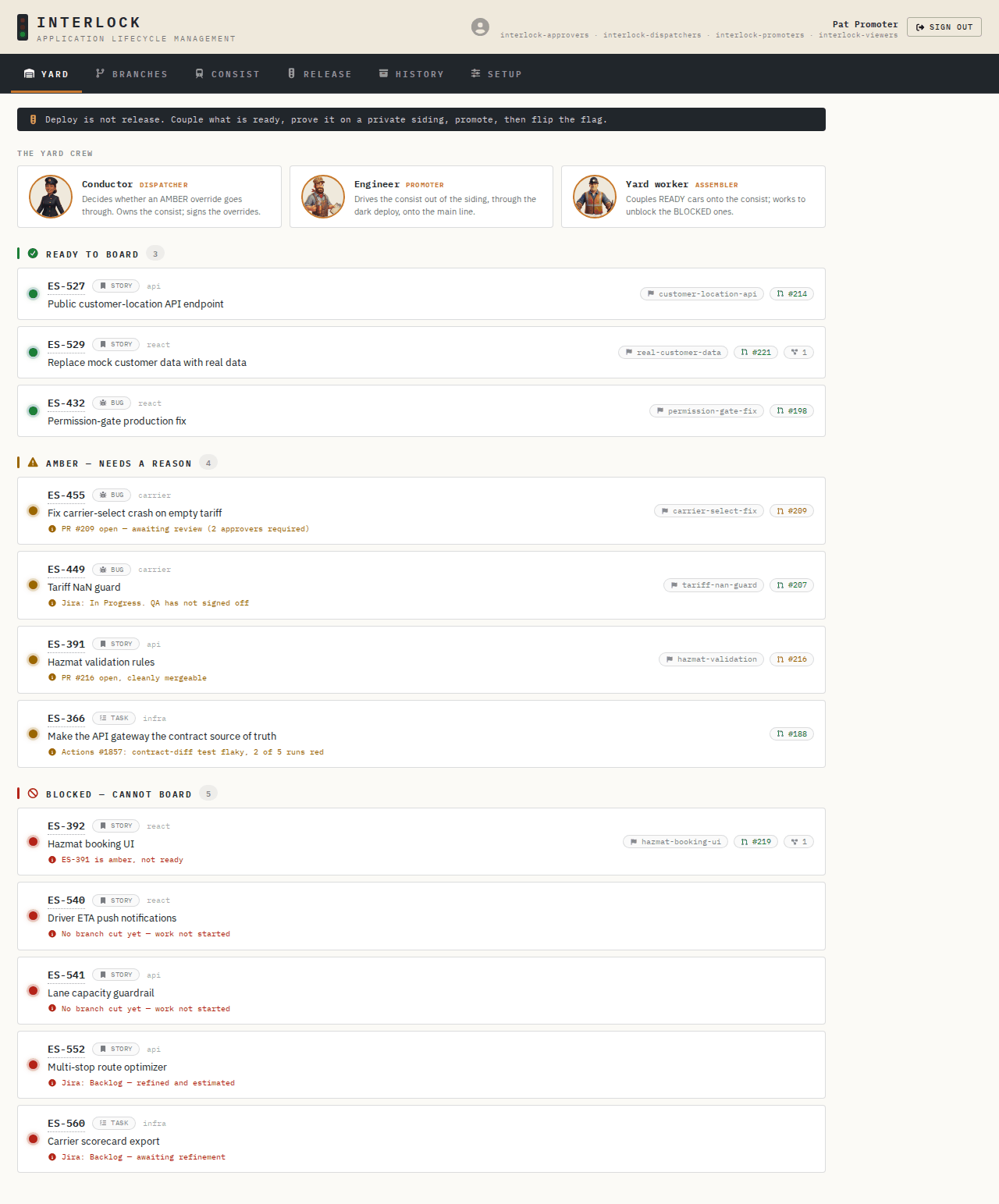
A release-orchestration control plane. It assembles dependency-ordered release candidates from work that is provably ready, proves them on an isolated ephemeral environment, promotes them to production deployed-but-dark at zero traffic, then exposes them to users only by deliberate, attributed feature-flag flips.
The AI story it started as six prototype screens from Claude Design, was reverse-engineered into a real spec with GitHub Spec Kit (8 user stories, 54 numbered requirements, an 11-area research pass). The research overruled the prototypes on three points where the platforms couldn't keep their promises as drawn. Eighty-five percent AI co-authorship, and the readiness algebra at its center is hand-written under 34 domain tests. That combination is the whole point.
What it teaches the roles live in the interface. The Conductor signs the override; the Engineer drives the dark deploy. A dev control panel then lets you drive the failure modes on purpose (knock CI red, take the flag control plane down, reject the next migration), so you learn the unhappy paths before production teaches them to you. It's a model train set for releases: the whole yard in miniature, derailments included.
Helix: change intelligence that survives the refactor
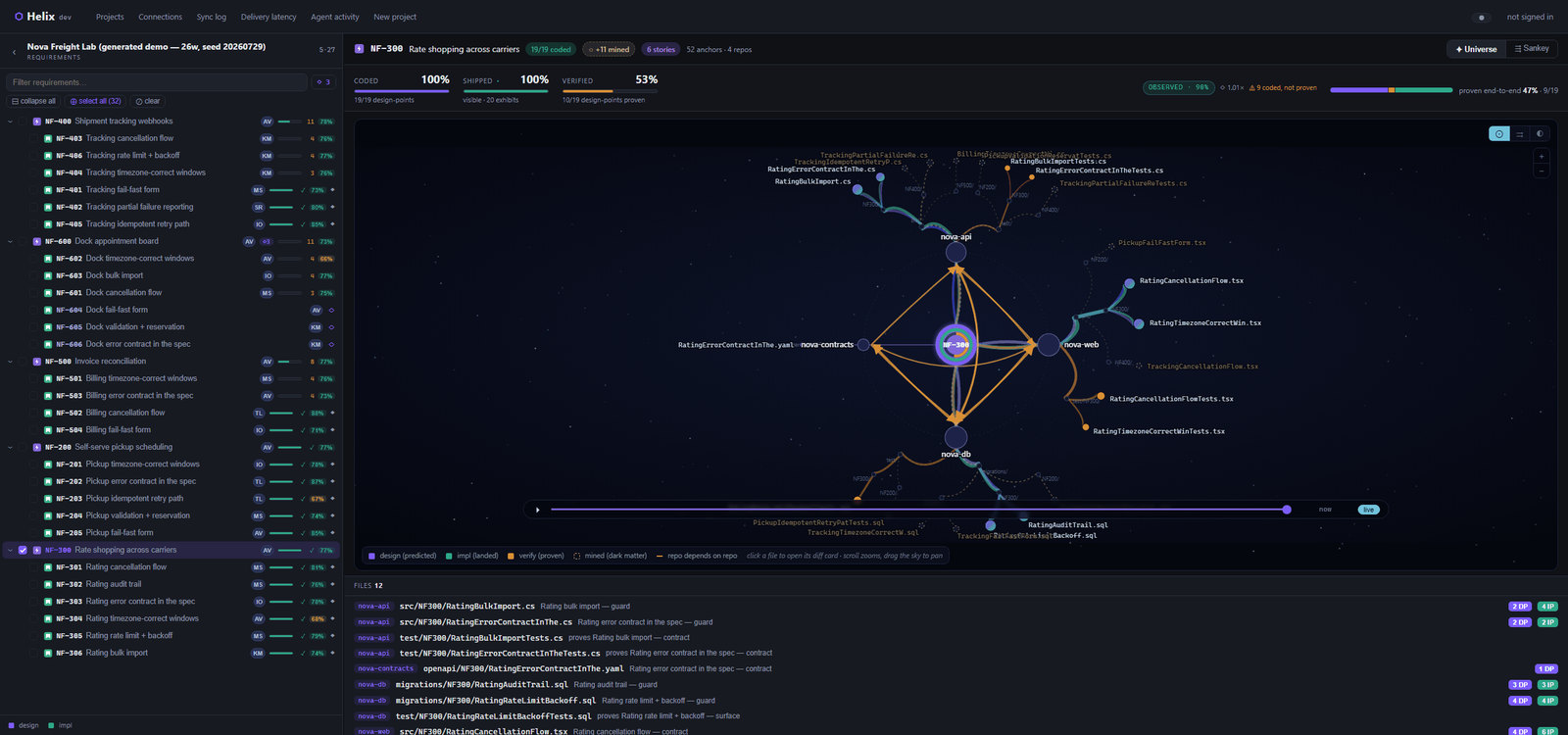
Helix ties a ticket to the exact span of code that implements it, stores that link as a small JSON file committed beside the code, and keeps it pinned to the right lines as the code moves. The links need no database, no server, no per-language parser.
The AI story Helix is built for agents. It ships an MCP server and two named research agents so
coding agents create and maintain the links themselves. Helix then re-validates every proposal
against HEAD, stamps provenance: agent, fails CI on anything orphaned, and flatly refuses
unreviewed agent-mined design points. It also plans the fan-out: helix plan-paths tells you how many parallel
agents your dependency graph can actually keep busy.
What it teaches three people ask "is it done?" and mean three different things. Helix reports all three and refuses to average them, because a single percentage answers one and misleads the other two. It also mines four years of history backwards, so a team that's never heard of it can start today.
I have been trying to build this since 2010. That year I published a CodePlex project called Requirements to Code Mapper for TFS. Internally it was named Helix, it used the terms design point and code implementation point, and its stated future vision was "a service to move function point location based on a merge." It broke the moment anyone refactored. Sixteen years later, the re-anchoring engine is that service, and agents maintain the links instead of a human remembering to. The 2010 write-up, with its original screenshots →
Cloud Topology Toolkit: infrastructure you can actually see
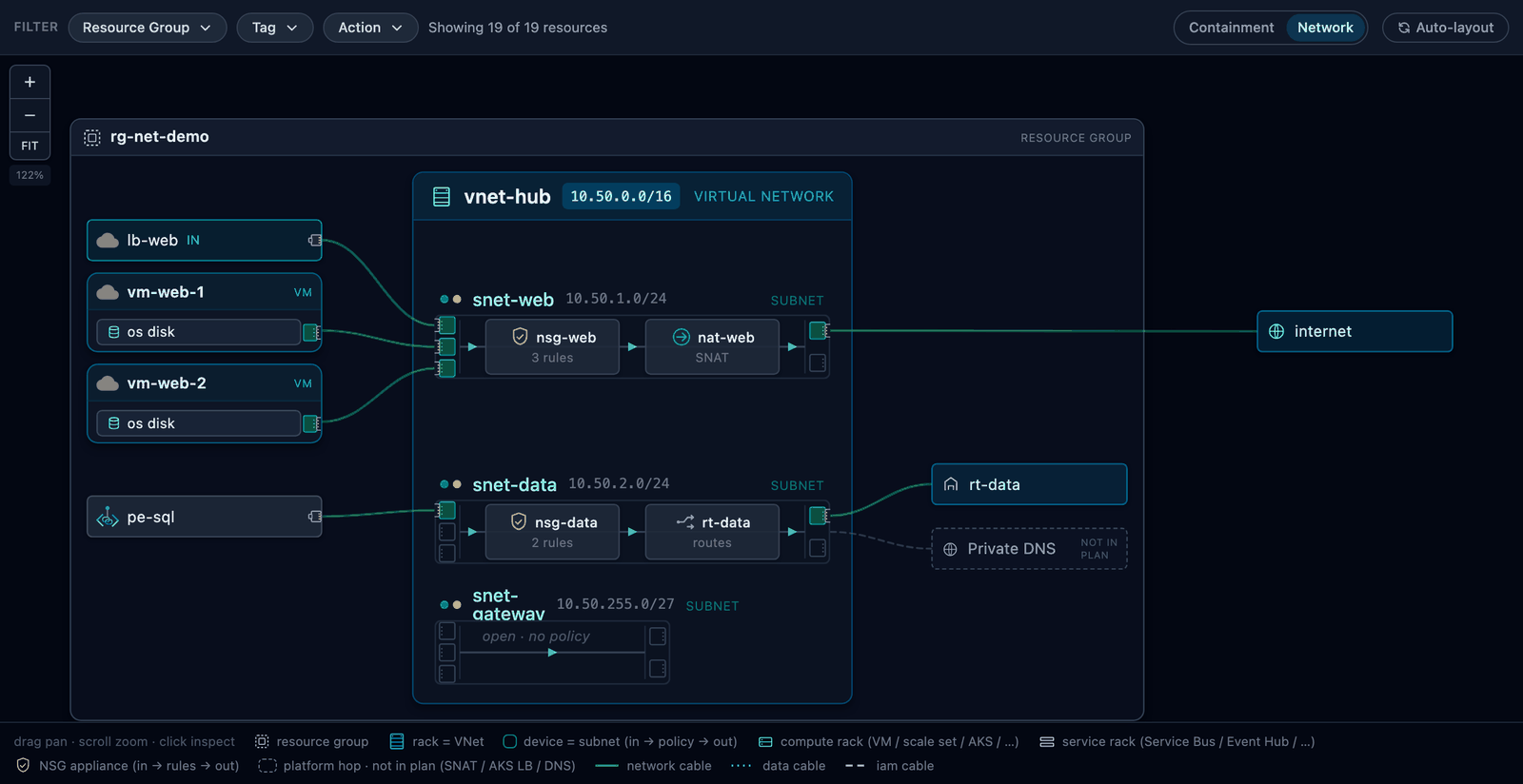
One intermediate representation fed by Terraform plans, Helm charts, live Kubernetes, and live cloud state, read by eight renderers including this interactive SPA. Hops Azure performs but never declares (platform SNAT, an AKS-managed load balancer, private DNS) are inferred and drawn as dashed "not in plan" appliances.
The AI story 117 commits authored outright by GitHub Copilot's coding agent working a real numbered issue queue. Held honest by content-hash golden tests and a constitution whose fourth principle is absence of correlation is observable, never faked.
What it teaches a four-thousand-line terraform plan becomes a picture a reviewer can actually
approve. Drawing the undeclared platform hops as confident solid lines would have been easier, and
would have taught people something false.
Runnin' Mules!: the counter-example
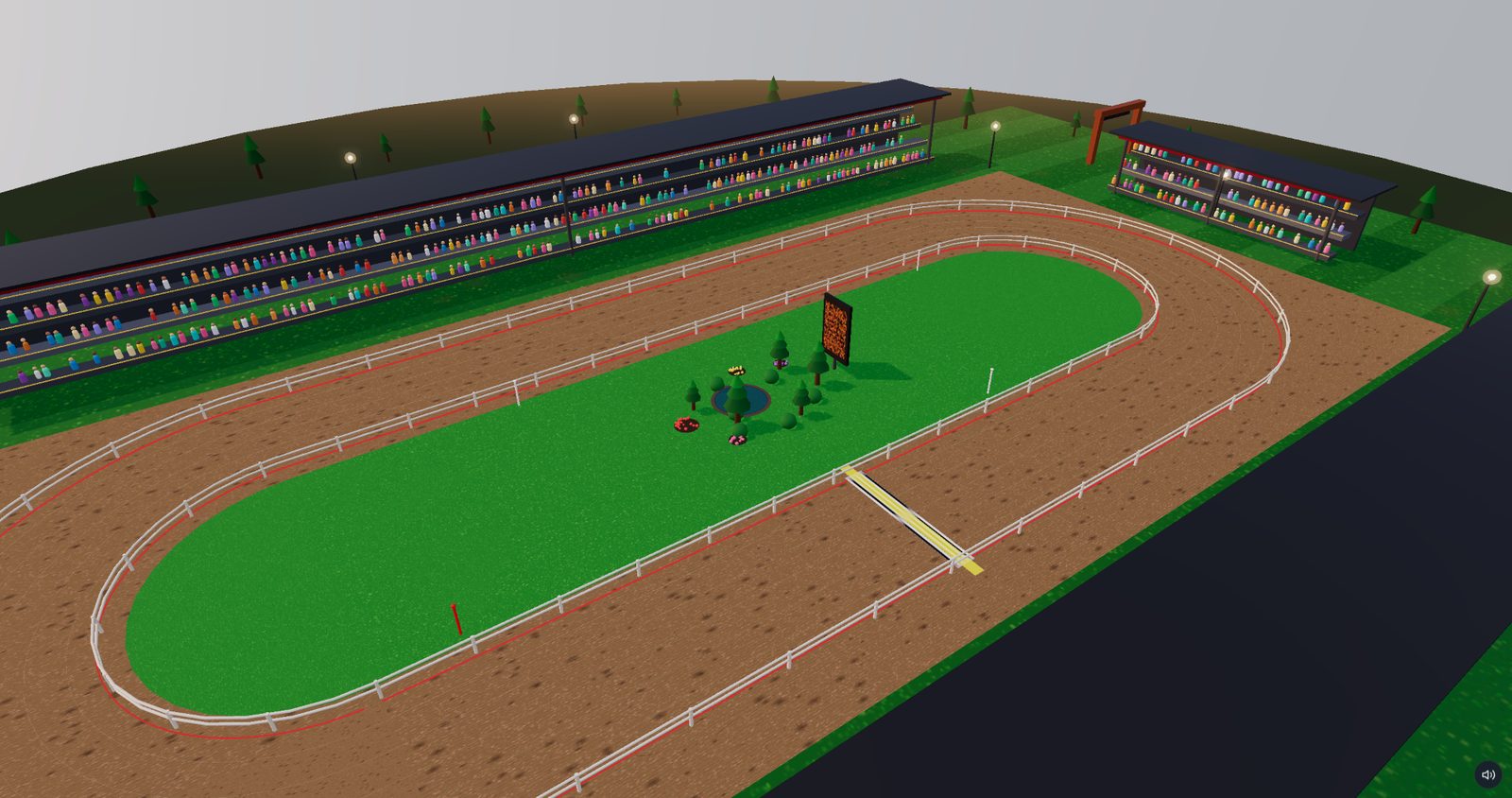
A real-time multiplayer horse-racing arcade: authoritative Socket.IO server, Rapier physics, phones pairing to a big-screen board by QR, a jockey rhythm minigame, and a ragdoll stumble that launches the rider into the grandstand.
The AI story this is generative AI in the product. Meshy-generated rigged 3D horses, a Google Chirp 3 HD broadcast announcer, generated splash art reused as the tutorial. Four disciplines I don't practice (3D art, rigging, voice, illustration), in one solo project that still shipped to Cloud Run with Grafana dashboards, Secret Manager, per-user rate limits, and semantic-release.
What it teaches it has a four-step first-time-player tutorial, because a game nobody can figure out in twenty seconds is a game nobody plays. Same instinct, lower stakes. And it settles an old account: a Sigma Derby of my own, first coveted on a Vegas casino floor, with the physical racetrack's Pi-and-Pico control stack in the same repo.
Play it runninmules.christaylor.ai. The stadium sleeps between races; the first visitor wakes it.
The part I get recognized for
Every tool above does the same underlying thing: it makes something invisible legible, so somebody else can act on it. Not one of them is for me. The same instinct runs through the curriculum at Coyote, the 3.5-developer turnaround at Next Generation Logistics, and the agent toolchain at Metafora that gives an agent the same context a new hire gets.
My fourth rule below, make the system say when it doesn't know, I wrote down as an engineering rule. It's really a teaching rule. The fastest way to make somebody worse at their job is to hand them a number that's confidently wrong, and most delivery tooling is confident precisely because it has stopped checking.
The full record on teaching, upskilling, and adoption →
How I work
Six rules, all learned expensively. The long version is here.
- Specs before agents. Agents are extraordinary at execution and poor at deciding what done means. The spec is where human judgment goes.
- Contract-first, then behavior. Freeze the shapes in OpenAPI, generate the DTOs, pressure-test the shell, then iterate logic. Agents drift on shapes and hold steady on logic.
- The guardrail is a gate, not a review. If the only thing between an agent and
mainis a human reading a diff, the human loses by volume. - Make the system say when it doesn't know.
nullmeans unmeasured;0means measured, and the answer is zero. They must never render the same way. - Plan the fan-out instead of guessing it. "How many agents can this work absorb?" is a measurable question.
- Watch the bill. An AI program without FinOps is a pilot, not a platform.
What people say
Verbatim from LinkedIn recommendations;
all twenty-nine are transcribed in .linkedin/recommendations.md. Twenty of
them independently describe teaching, mentoring, or force multiplication. That was not a theme I picked.
"Some people are so good at what they do that when they join a project they change the laws of physics. They prevent the fire from ever happening, they subsidize the individual gaps of the team to create a multiplier effect, and they make the show-stopper problems seem easy."Tim Stall, Chief AI Officer at Authava (my client)
"He played a pivotal role in operationalizing Kubernetes, implementing ephemeral environments, migrating to GitHub, adopting Power Platform, leveraging AI... These initiatives substantially improved developer productivity, organizational agility, and IT's overall business value... One of his favorite phrases is 'let me share my screen' because he is eager to teach and exceedingly generous with his time."Brian Boos, SVP, Information Technology at CMG (managed me directly)
"He and his team put together a training program specifically to educate those elsewhere in the organization and expose them to new ideas they might not otherwise become familiar with, always encouraging a deeper level of inquiry and learning."Steven J. Vinelli, Senior Systems Engineer at RXO
"Chris's desire to innovate is only matched by his desire to teach. When you're working on a project with Chris, you're going to be walking away with new tools under your belt."Gavin Borgeson, Cloud Engineer at Coyote Logistics
"He has mentored me and my growth over the year was exponential due to his dedication to teaching."O'Neil Son, AVP, Cloud Network Architect at Zurich North America
"The depth of knowledge Chris has in the Azure space is an asset that has taken us from 'a foot in the door of cloud' to 160+ services terraformed, containerized, and confident we're doing it on a rock solid foundation... He has really been a force multiplier for us at Coyote."Joe Kolodz, Coyote Logistics
"He is a superhero. He swoops in with great knowledge, skill, intelligence and experience to respond to calls for help... He not only coaches, but when needed, he will roll up his sleeves, grab on and help lift heavy objects."Monica Stettler Brozny, Director, Data Science & MLOps at RXO
The one I find most telling is Stephen Tanksley, a senior data engineer who had never worked with me at all. We met in a LinkedIn comment thread. He wrote a recommendation about being mentored anyway: "he didn't allow me to assume I had little value to immediately contribute. He encouraged me to set my goals higher than I previously had and continues to do so."
Stack
Grouped by what it's for rather than by vendor.
- AI engineering · Microsoft Agent Framework · Model Context Protocol (MCP) · Anthropic API and Claude Code · Azure AI Foundry · Vertex AI · multi-agent orchestration, A2A (agent-to-agent) and A2P (agent-to-person) · RAG and vector search (pgvector) · prompt and context engineering · GitHub Copilot administration and rollout
- Making AI provable · Langfuse tracing · batch rubric evaluators · golden and back-tested outputs · structured-output recovery from truncated responses · token cost controls and caching at the gateway
- Cloud and platform · Azure · GCP · AWS · Kubernetes (AKS/GKE) · Helm · Terraform · Dapr · KEDA · Container Apps · Cloud Run · Lambda · API Gateway
- Languages · C#/.NET · TypeScript/React · Python · PowerShell · Node · SQL
- Delivery and release engineering · GitHub Actions/GHAS/Codespaces · Azure DevOps · ArgoCD · LaunchDarkly (including session replay) · progressive delivery and dark launch · contract-first OpenAPI · Playwright
- Observability · OpenTelemetry · Prometheus · Grafana · Loki · Serilog/SEQ · Azure Monitor · Cloud Monitoring
- Identity · Entra ID · Okta · Authentik · Keycloak · OAuth2/OIDC
- Enablement · curriculum design · adoption programs · developer onboarding · ADRs and technical standards · FinOps, including AI spend · mentoring to certification
Full breakdown in experience.md.

Still true. AI just made the first half free.